
Resistance Bands

📖 Table of Contents
Resistance bands are versatile, portable, and effective tools for strength training, rehabilitation, and enhancing flexibility. Whether you're an athlete, a physical therapy patient, or someone looking to improve overall fitness, resistance bands can be tailored to your needs and fitness level.
Unlike traditional weights, resistance bands provide continuous tension throughout the entire range of motion, making them ideal for building strength, increasing muscle endurance, and improving joint stability. They are particularly beneficial for people with mobility limitations or those recovering from injuries.
This guide explores the full spectrum of resistance band usage, from general strength training to targeted knee workouts and pain management. Whether you're looking to build muscle, support joint health, or alleviate discomfort, resistance bands offer a solution that is both accessible and effective.
Key Takeaways
- Resistance bands are a versatile, low-cost alternative to free weights for strength and flexibility training.
- They are especially beneficial for knee workouts, providing support and stability for joint health.
- Resistance bands can be used to alleviate pain and improve mobility in individuals with chronic or acute conditions.
- Proper technique and band selection are crucial to maximize benefits and avoid injury.
Resistance Bands
As of August 2026, Resistance bands are made from high-quality, durable materials such as natural rubber or latex, and come in a range of resistance levels to suit all fitness levels and goals. They are widely used in physical therapy, fitness training, and rehabilitation due to their versatility and effectiveness.
According to a 2022 study published in the Journal of Strength and Conditioning Research, resistance band training can improve muscle strength and endurance comparable to traditional weight training. This makes them a popular choice for both beginners and advanced athletes.[1]
A practical example of their use is in home workouts, where individuals can perform exercises like bicep curls, squats, and shoulder presses without the need for heavy equipment. The portability of resistance bands makes them ideal for travel, home use, or on-the-go fitness routines.
In this guide:
In this guide:
In this guide:
In this guide:
Knee Workout

Knee workouts with resistance bands focus on strengthening the quadriceps, hamstrings, and hip muscles that support the knee joint. These exercises are particularly beneficial for individuals with knee pain, arthritis, or those recovering from knee surgery.
One popular exercise is the 'clamshell' movement, where the band is placed around the thighs and the knees are lifted while keeping the feet together. This exercise targets the gluteus medius, which plays a key role in knee stability.
A study in the Journal of Orthopaedic & Sports Physical Therapy found that resistance band exercises can significantly improve knee function and reduce pain in patients with osteoarthritis. This makes resistance band workouts a valuable addition to knee rehabilitation programs.[2]
Related: Workouts Runners
Related: What Are Knee Highs Workout
Related: Exercise Bands With Handles
Related: Elliptical Workout Calories Calculator
Related: What Is The Little Gym
Related: Exercise Bands Or Weights
Related: What Is The Best Way To Workout Abs
Related: Knee Strengthening With Resistance Bands
Related: Incline Dumbbell Curl
Related: What Is The Gym Exercise
Related: The Best Under Desk Treadmill
Related: Inner Thigh Workout
Related: What Is The Gym Membership
Related: What Is Planet Fitness New Equipment
Pain
For individuals experiencing chronic pain or recovering from an injury, resistance bands offer a low-impact way to build strength and improve mobility without exacerbating pain. They are commonly used in physical therapy to support recovery from conditions like plantar fasciitis, lower back pain, and knee osteoarthritis.
A specific example is the use of resistance bands in the 'wall sit' exercise, which helps strengthen the quadriceps and reduce knee pain by improving joint alignment. This exercise can be modified to accommodate different levels of pain and mobility.
According to a 2021 review in the Journal of Pain Research, resistance band training has been shown to reduce pain and improve quality of life in individuals with chronic musculoskeletal conditions. This underscores their effectiveness as a tool for pain management and rehabilitation.[3]
“Resistance bands are versatile, portable, and effective tools for strength training, rehabilitation, and enhancing flexibility.”— Knee Friendly Elliptical Workouts editors
Related: Stretching Knee Joint
Expert Tips and Advanced Techniques
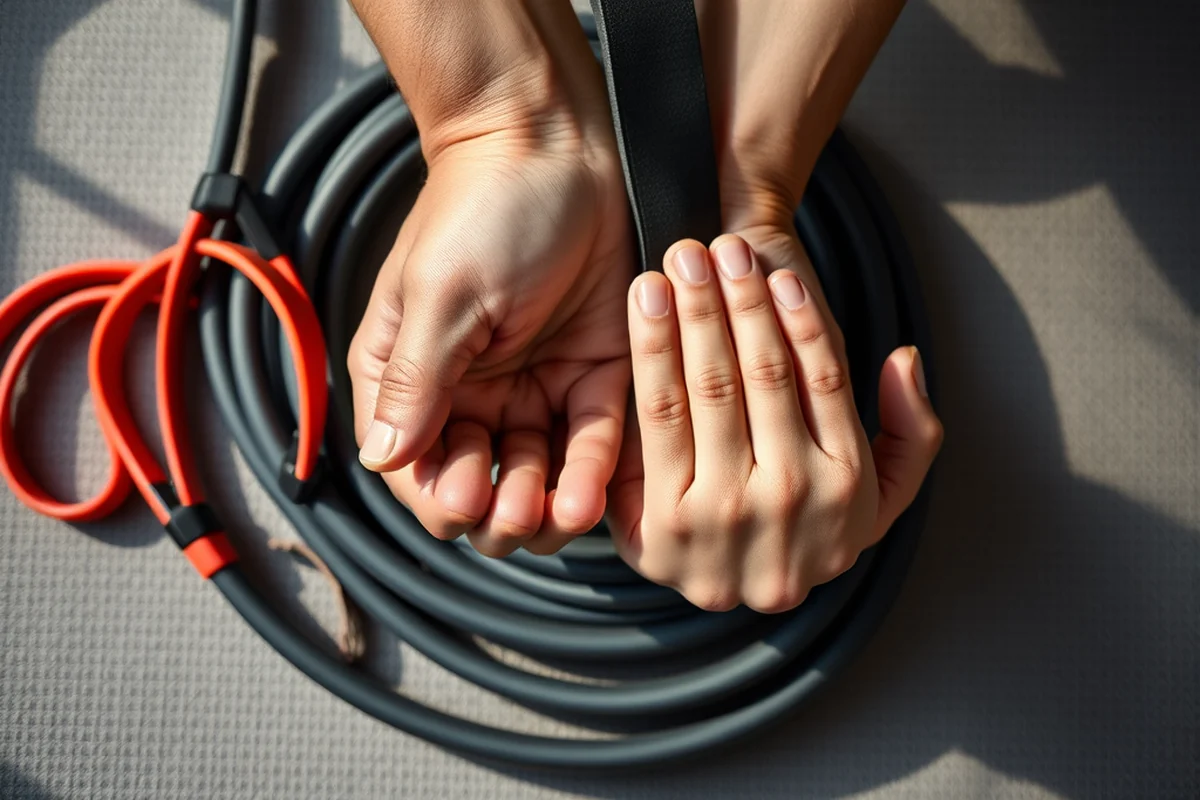
Advanced users can incorporate bands into complex movements like band pull-aparts, sled drags, and rotational exercises for core and functional strength. Focus on controlled tempo and full range of motion to maximize muscle engagement and prevent injury.
Using bands for eccentric training—such as slowing down the lowering phase of a squat or row—can increase muscle hypertrophy and strength gains. Pairing bands with bodyweight or free weights adds progressive overload for advanced training.
Experiment with different band tensions and anchor points to create varied resistance profiles. Techniques like band-assisted pull-ups or isometric holds help build strength and improve movement precision.
Tools, Materials and Resources
Invest in high-quality resistance bands made from durable natural rubber, with varying tension levels for different exercises. Look for bands with handles, door anchors, and carrying cases for convenience and versatility.
Complement your bands with workout mats, foam rollers, and resistance band loops for added functionality. Apps and online platforms offer guided workouts, progress tracking, and video tutorials for all fitness levels.
Explore books, online courses, and certified trainer programs to deepen your understanding of resistance band training. Communities and forums provide support, motivation, and tips for consistent progress.
Troubleshooting and Common Questions
If your resistance bands are slipping or not providing enough tension, check for wear and tear or improper grip. Using grip-enhancing gloves or applying chalk can improve traction. If the band is stretching too much or breaking, it may be past its useful lifespan and should be replaced for safety.
Common questions include how to choose the right resistance level, how to incorporate bands into a full-body workout, and whether they can replace free weights. The answer often depends on individual fitness goals, with bands being excellent for mobility, strength, and rehabilitation when used correctly.
Another frequent concern is how to prevent bands from snapping. Always inspect them for cracks or tears before use, avoid over-stretching, and store them in a cool, dry place. If you're unsure about proper technique, consult a fitness professional or use reputable online resources to ensure safe and effective training.
Getting Started: Your First Steps
To begin, select a resistance band that matches your fitness level. Lighter bands are ideal for beginners, while heavier ones are better for advanced users. It's also helpful to invest in a set that includes multiple tension levels for variety and progression.
Familiarize yourself with basic exercises such as squats, chest presses, and glute bridges. These movements are great for building foundational strength and can be easily adapted to different resistance levels. Start with bodyweight versions before adding resistance.
Create a dedicated workout space that is free of obstacles and has enough room to move. Using a mat or carpeted surface can help protect your floors and provide better grip. Consistency is key, so aim for short, focused sessions at least three times a week to build momentum.
🌱 Beginner
The simplest version — minimal supplies, quick win.
💰 Budget
Same result using what you already have.
⚡ Quick
The 10-minute version for busy days.
✨ Advanced
The upgraded version once the basics stick.
| The mistake | Why it happens | The fix |
|---|---|---|
| Using resistance bands with improper tension for the exercise. | Using a band that's too loose can reduce the effectiveness of the exercise, while a band that's too tight may cause strain or injury. | Choose a resistance band with the appropriate tension level based on your fitness goals and strength level. |
| Ignoring proper form during knee workouts. | Poor form during knee workouts can lead to improper muscle engagement and increase the risk of injury or pain. | Maintain proper alignment and engage core muscles to ensure safe and effective execution of each movement. |
| Overusing resistance bands without rest. | Overusing resistance bands without allowing muscles time to recover can lead to overtraining, fatigue, and potential injury. | Incorporate rest days into your routine and vary the intensity of your workouts to promote recovery. |
Common Questions
What are some knee band exercises that are effective for strength?
What is a knee workout cushion and how is it used?
What are some knee stretches for pain relief?
Can resistance bands be used for people with knee pain?
References
- Stronger Every Move: Resistance-Band Exercises (aces.edu)
- The cardiovascular health benefits of resistance training (canr.msu.edu)
- Resistance band training for osteoporosis prevention (DVD) (catalog.library.nashville.gov)
- Effects of strength training with variable elastic resistance across the ... (ccd.ucam.edu)
Cite this guide
Knee Friendly Elliptical Workouts (2026). Resistance Bands. https://mildmotion.com/resistance-bands/
Feel free to cite or share this guide.